When a tree is not enough:
Inferring Viral Reassortment Networks
Stadler Group, D-BSSE, ETH Zürich
Methods and Beers #11 - Making Connections, 10th October, 2019



The Influenza Virus
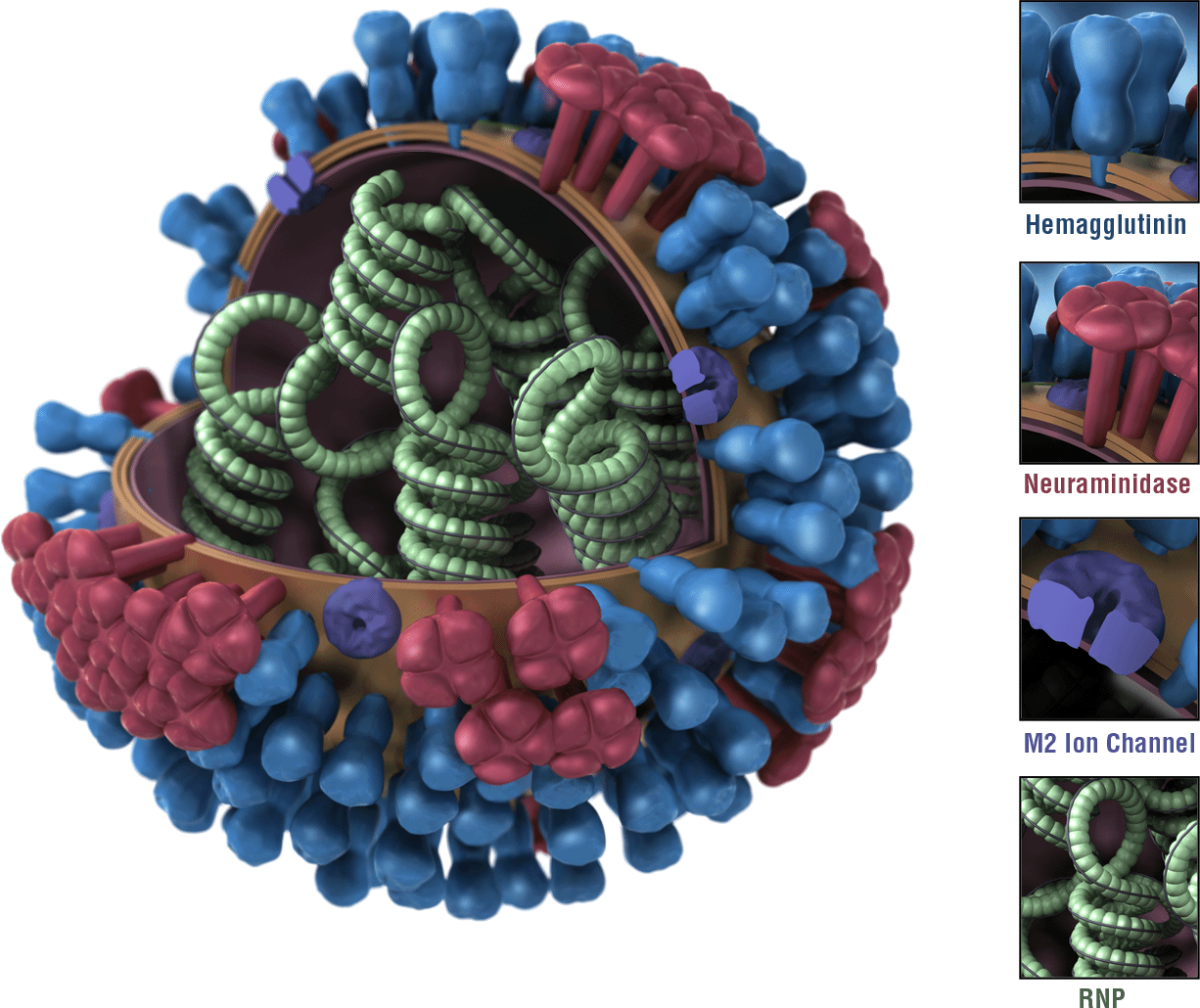
www.cdc.gov
Viruses with segmented genomes
- To date, 11 distinct families of segmented viruses have been described.
- Specific examples include:
- Lassa virus (2 segments)
- Influenza virus (8 segments)
- Rotavirus (11 segments)
- Reassortment known to play an important role in the generation of new strains (e.g. 2009 Swine flu outbreak).
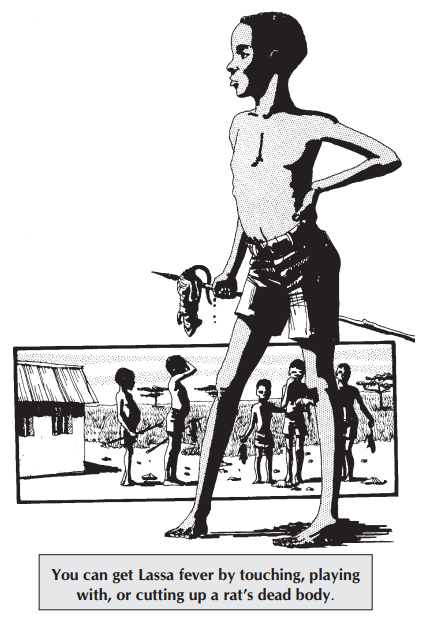
Wikipedia
Reassortment
- A single cell may be coinfected by multiple viruses, potentially of different strains.
- Genome segments from different "parent" virions may be packaged into the same "daughter" virion.
- For influenza, this is an important source of genetic diversity.
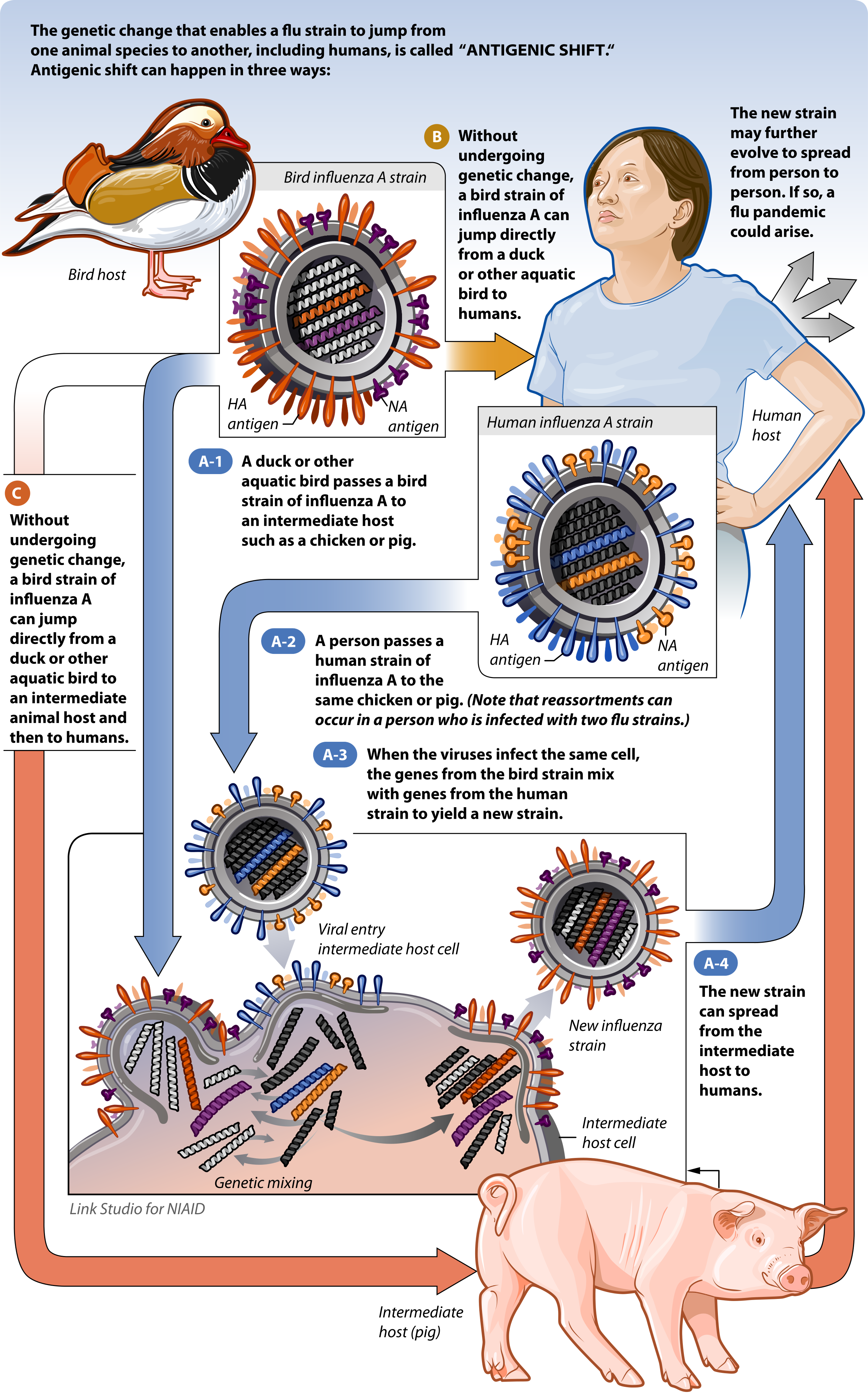
Wikipedia
Reassortment vs Recombination
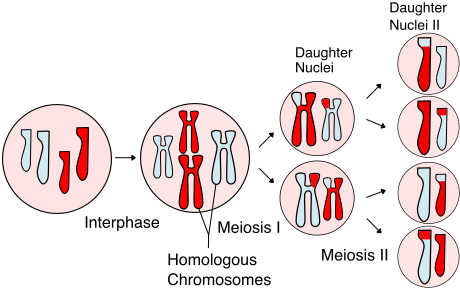
Wikipedia
Phylogenetic consequences
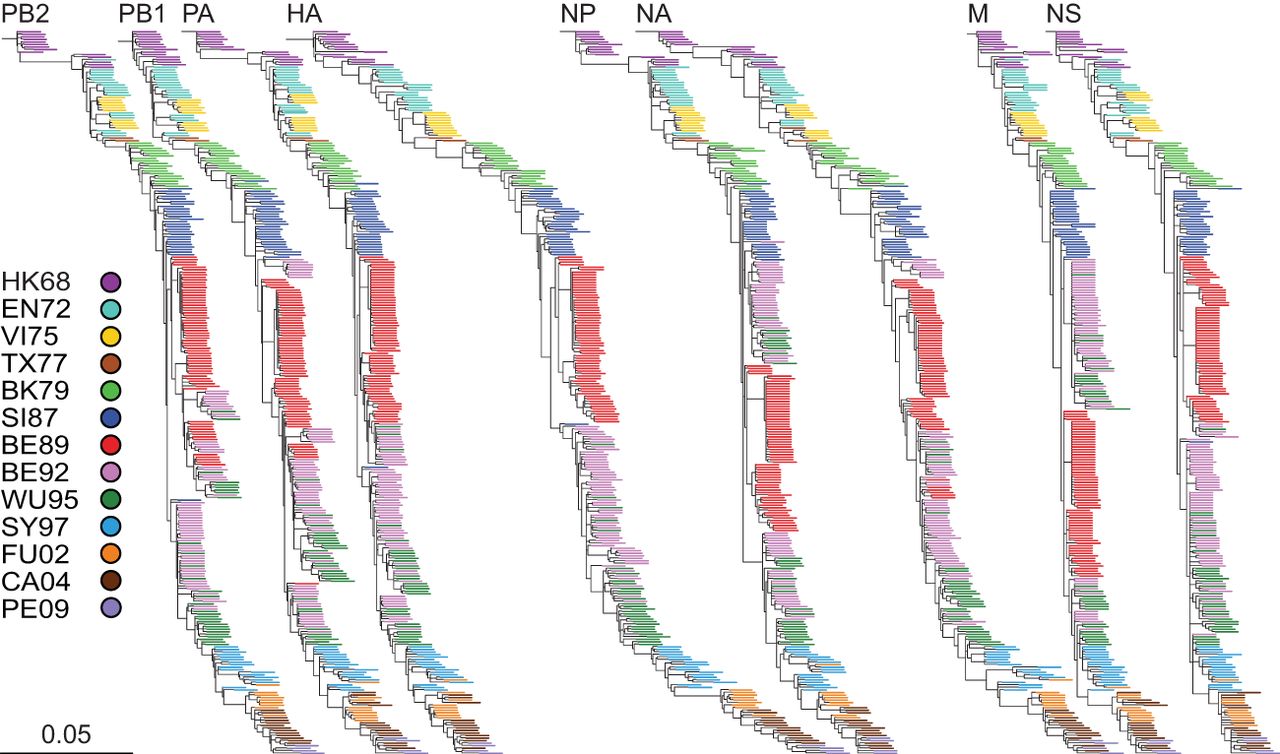
Westgeest et al., J. Virol., 2014
Research questions

- How well can we pin-point reassortment events using genetic data?
- How frequently does reassortment occur in different viruses?
- For zoonotic viruses, does host type affect rate?
Traditional approaches
Existing approaches to quantitatively inferring the presence and rate of reassortment in viral genomes fall into two groups:
- Population genetic approaches
- These look at allele frequency spectra for evidence of reassortment. (E.g. Leonard et al., PLoS Path., 2017)
- Phylogenetic comparison approaches
- These attempt to reconstruct reassortment events by comparing inferred segment trees. (E.g. Svinti et al., BMC Evol. Biol., 2013)
H3N2 Tanglegrams
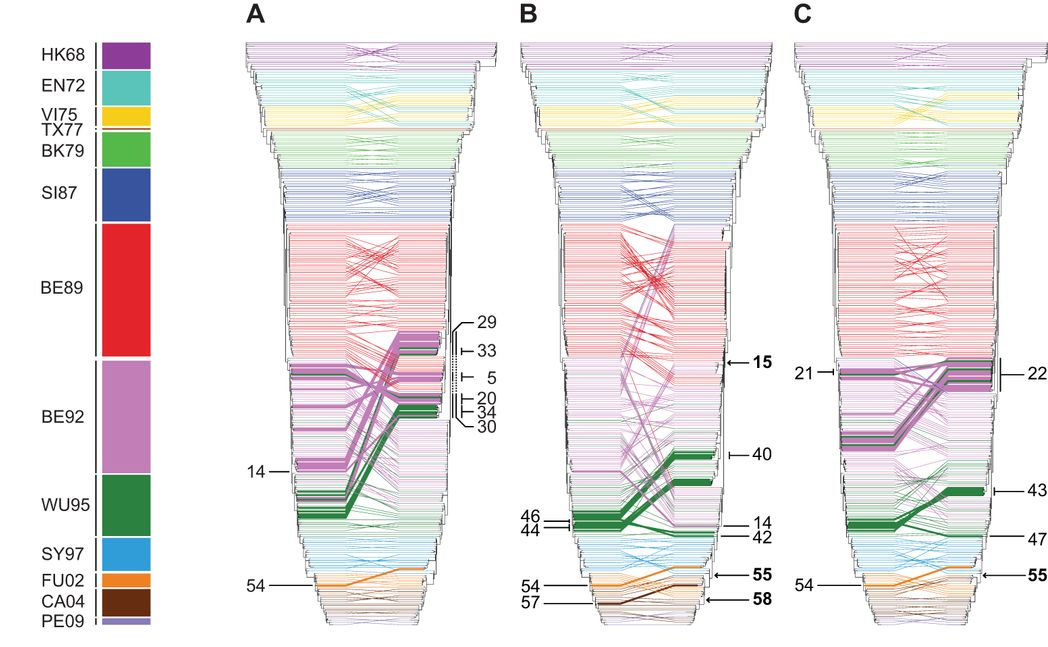
Westgeest et al., J. Virol., 2014
Can we develop a more principled, model-based approach to learning about and treating the reassortment process?
The Coalescent with Reassortment
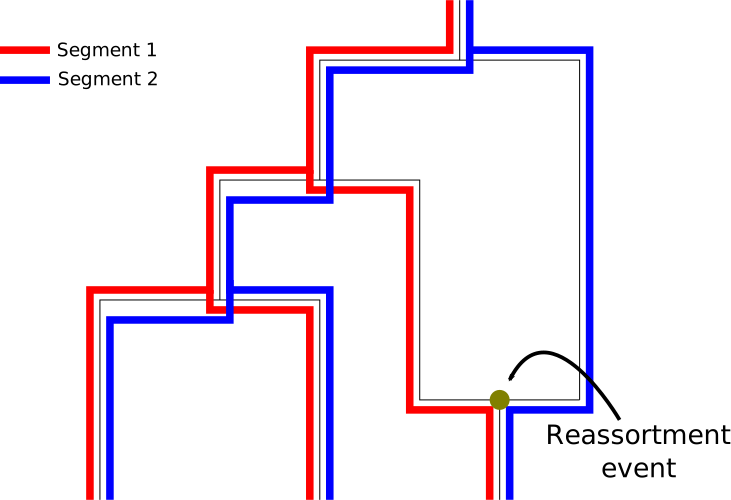
Proposed coalescent model
Model parameters are:
- Coalescent rate $1/N_e$
- Per-lineage reassortment rate $\rho$
Identical to Hudson's model of coalescent with recombination, but with unordered segments taking the place of the ordered sites.
Simulated reassortment network
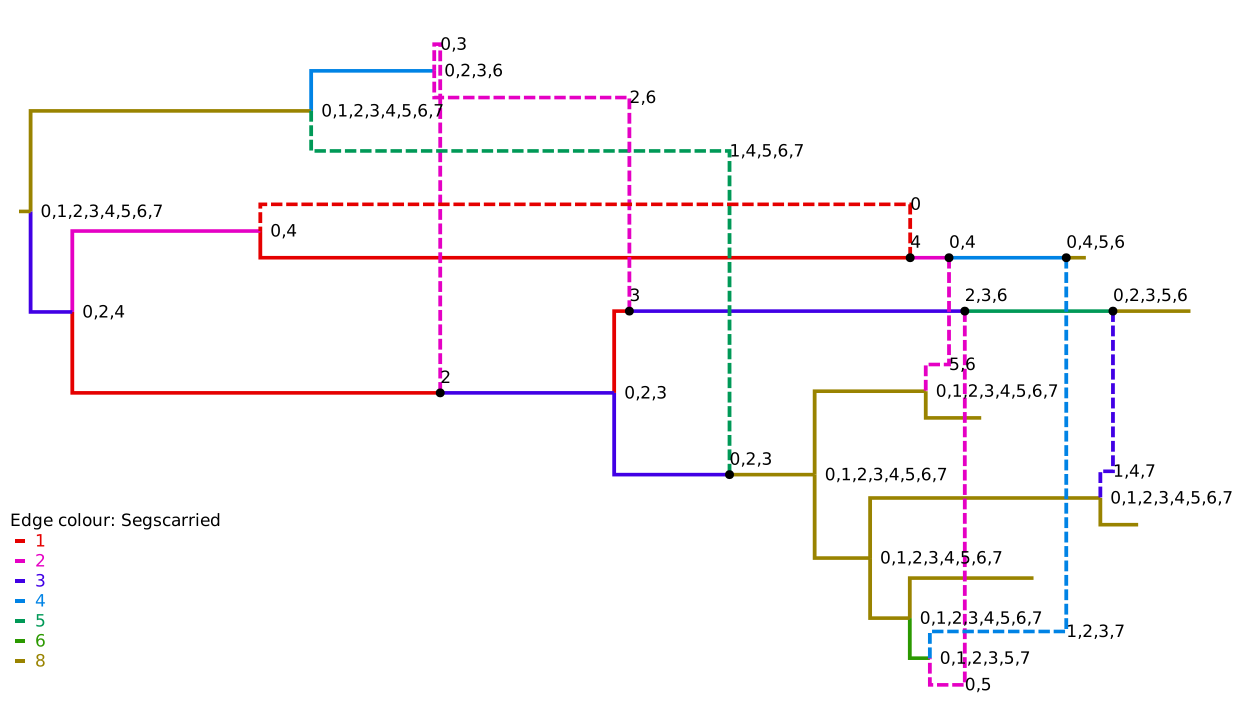
Comparison with species networks
Reassortment network
![]()
Species network
![]()
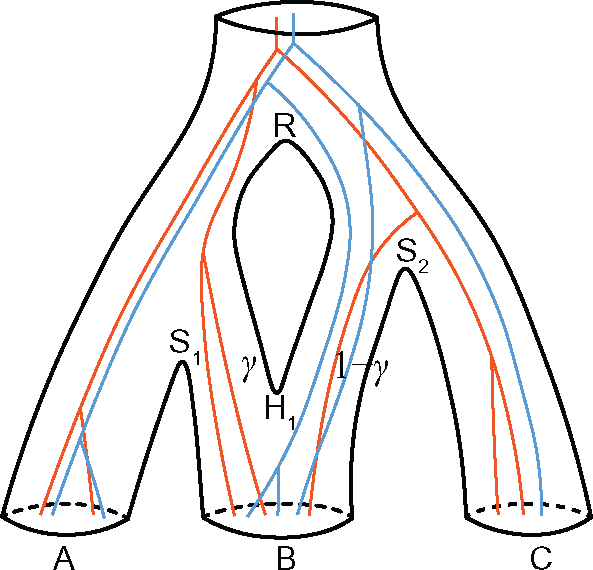
Zhang et al., MBE, 2017
Bayesian Inference
Can perform infernece by characterizing the reassortment network posterior:$$P(G,\mu,N,\rho|\vec{A}) = \frac{1}{P(\vec{A})}P(\vec{A}|G,\mu)P(G|N,\rho)P(\mu,N,\rho)$$
- $\vec{A}$ is the vector of segment alignments.
- $G$ is the segment network, displaying segment trees $\vec{T}$.
- $P(\vec{A}|G,\mu)$ is the likelihood of the network and is easily expressed as a product over segment trees: $$P(\vec{A}|G,\mu)=\prod_i P(A_i|T_i,\mu).$$
- $P(G|N,\rho)$ is the network prior under the coalescent with reassortment model.
Can we perform MCMC on the space of reassortment networks to characterize this posterior?
Reason for Hope
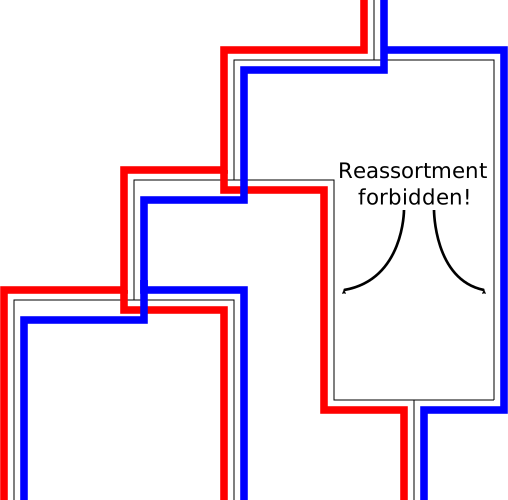
Observed reassortment rate diminishes as more reassortments occur: hugely reduced state space when only small numbers of segments are considered.
MCMC algorithm kernel
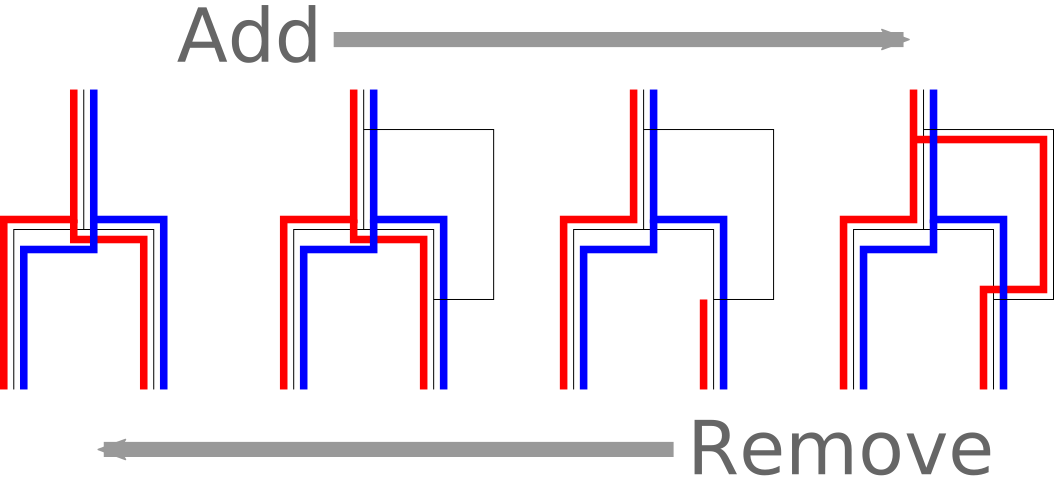
- Easy to show this is universal.
- Other operators also necessary to make this efficient.
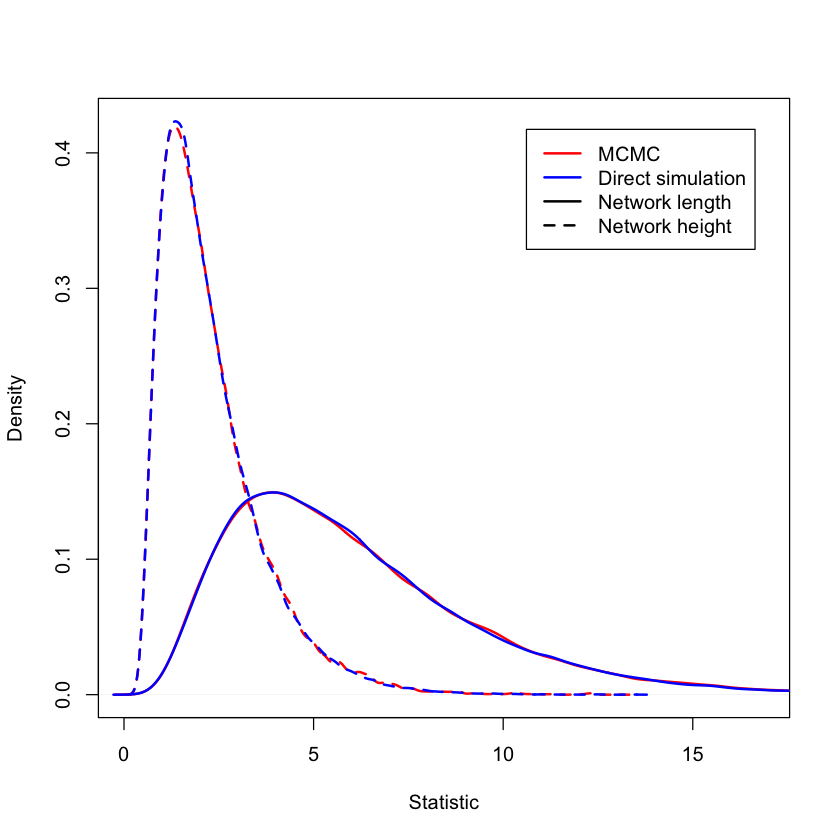
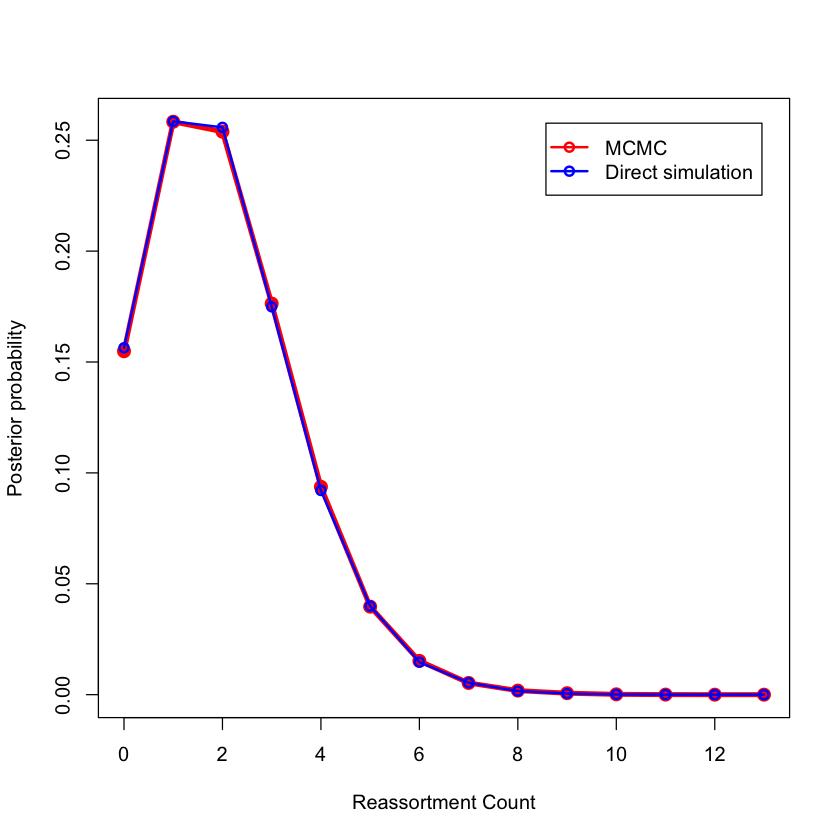
Validation: Sampling from the prior
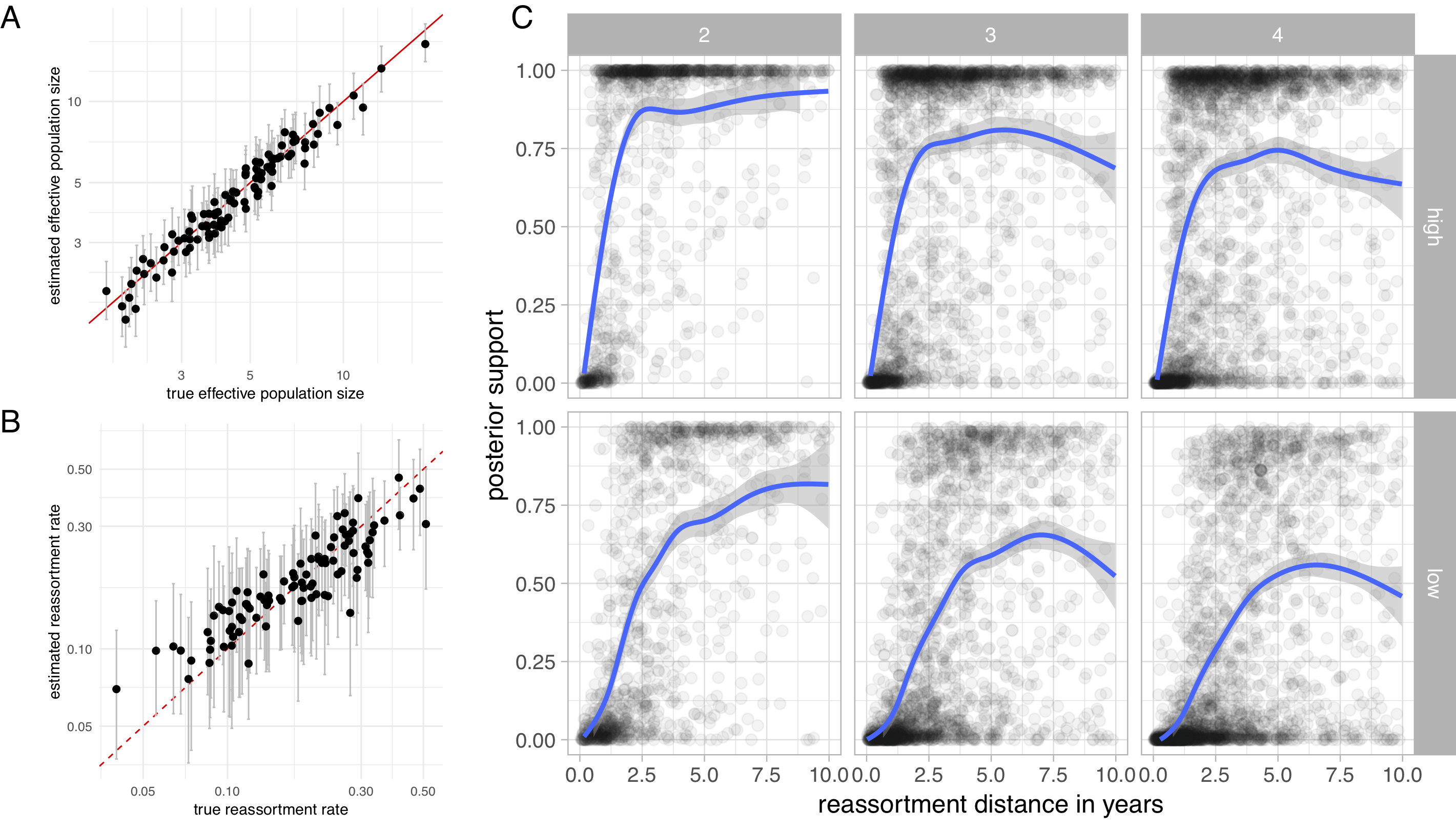
Validation: Inference from data
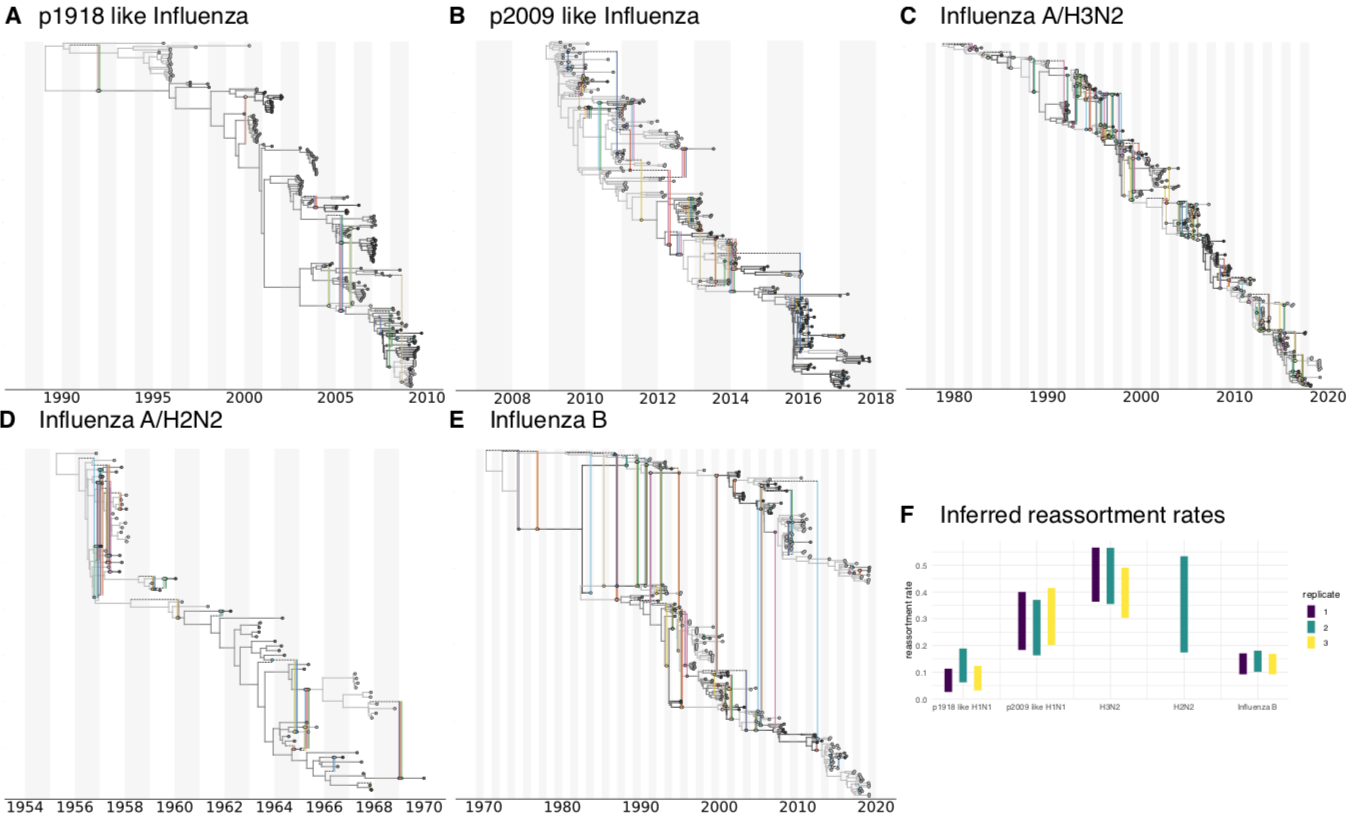
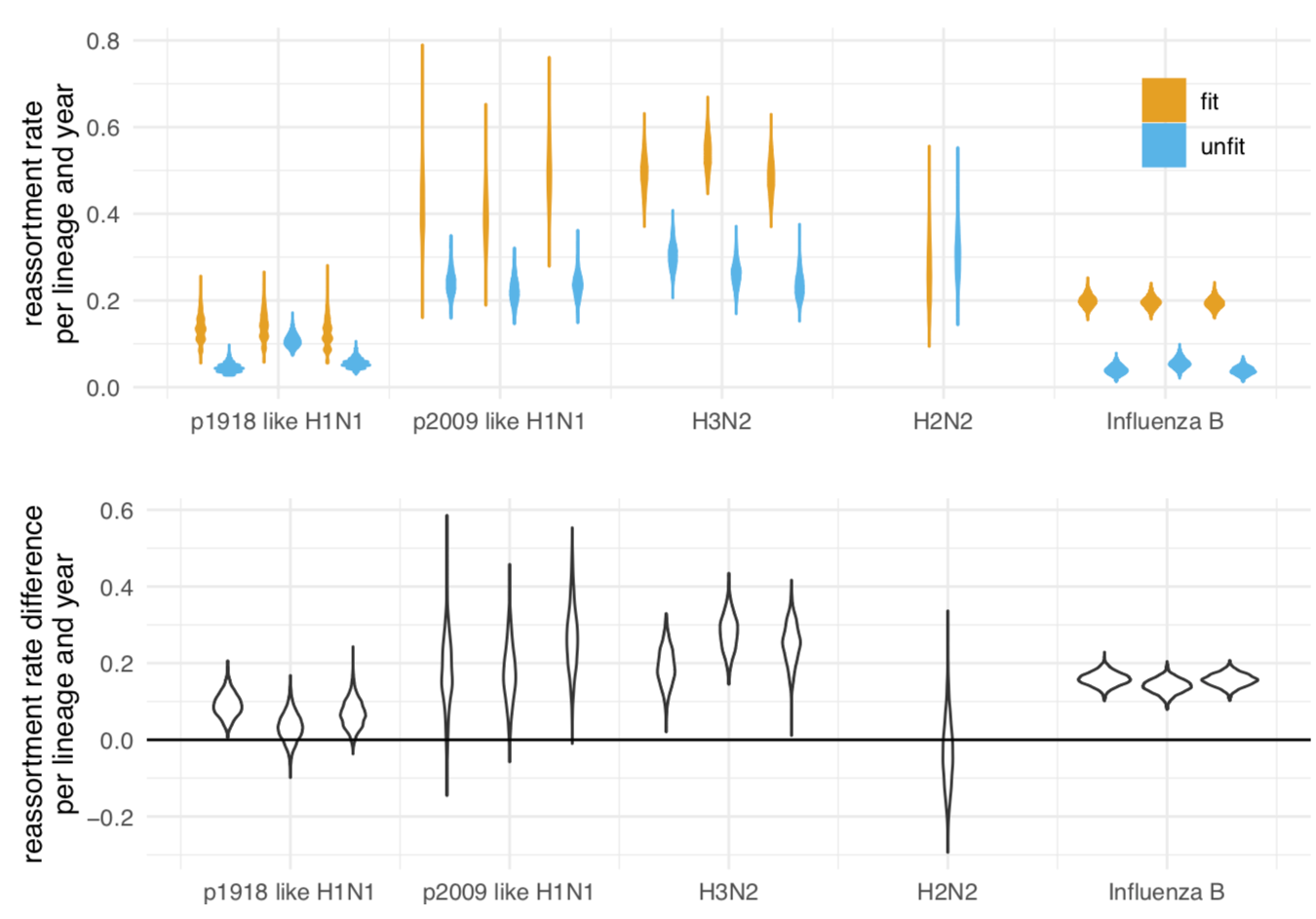
Application to Influenza
Fitness dependence
BEAST 2 Package: CoalRe
- Coalescent with reassortment model implemented as the BEAST 2 package CoalRe.
- Usage tutorial available at:
taming-the-beast.org/tutorials/Reassortment-Tutorial - Preprint describing model and Influenza results available at: www.biorxiv.org/content/10.1101/726042v1
Acknowledgements
- Nicola Müller: lead author and principle developer
- Ugnė Stolz: testing and extension to structured populations
- Gytas Dudas: viral phylodynamics expert
- Tanja Stadler: project supervision
- The rest of the cEvo group!